The Mineralogical Museum preserves, studies, and exhibits actual scientific rock material in the form of mineral and rock samples.
The Mineralogical Museum's exhibition is distinguished by its high scientific value and representativeness and consists of over 14,000 samples from all continents of the Earth. It contains reference, typical, and rare minerals that reflect the diversity of the mineral world, the peculiarities of crystal chemistry, and the conditions for the formation of mineral associations.
The mineralogical collection serves as a basis for research in the fields of mineralogy, petrography, and geochemistry and provides a visual demonstration of the processes that determine the structure and evolution of the Earth's crust.
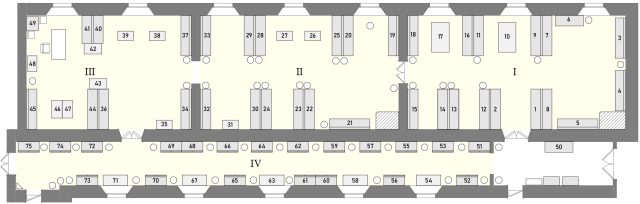
19. Native minerals
20. Sulfides
21. Sulfosalts, sulfoarsenides
22. Halides, vanadates, tungstates
23. Oxides
24. Oxides, borates
25. Carbonates
26. Calcite
27. Barite, gypsum
28. Sulfates
29. Phosphates, arsenates
30. Island silicates: orthosilicates (non-silicates) and diorthosilicates (sorosilicates)
31. Sulfates
32. Island (sorosilicates) and ring (cyclosilicates) silicates
33. Chain silicates (inosilicates)
34. Ribbon silicates (inosilicates)
35. Unique exhibits
36. Framework silicates (tectosilicates)
37. Layered silicates (phyllosilicates)
38. Chalcedony, jasper, agate, opal
39. Quartz
40. Layered silicates (phyllosilicates)
41. Temporary exhibition
42‒43. Gemstones
44. Framework silicates (tectosilicates)
45. Meteorites
46. Tektites
47. Impactites
48. History of mineralogy
49. Pseudomorphoses: petrified wood
50. Decorative and utility stones
51. Minerals of Ukraine: Carpathian folded system and its border
52. Minerals of Ukraine: Volyn-Podilsky plate
53. Minerals of Ukraine: Ukrainian shield
54. Works of participants of thematic master classes
55. Minerals of the evaporite process: halides
56. Minerals of the sedimentary process
57. Minerals of the evaporite process: sulfates
58. Collection of gypsum from Optimistic cave
59. Minerals of low-temperature hydrothermal process
60‒61. Contact metamorphic minerals: skarn minerals
62. Medium-temperature hydrothermal minerals
63. Grown crystals
64. High-temperature hydrothermal minerals
65. Pneumatolite-hydrothermal minerals: greisen minerals
66. Quartz druses
67. Fluorite
68–69–70. Pegmatite minerals
71. Deep xenoliths
72. Volcanic minerals
73. Regional metamorphic minerals
74. Normal igneous minerals
75. Alkaline igneous minerals